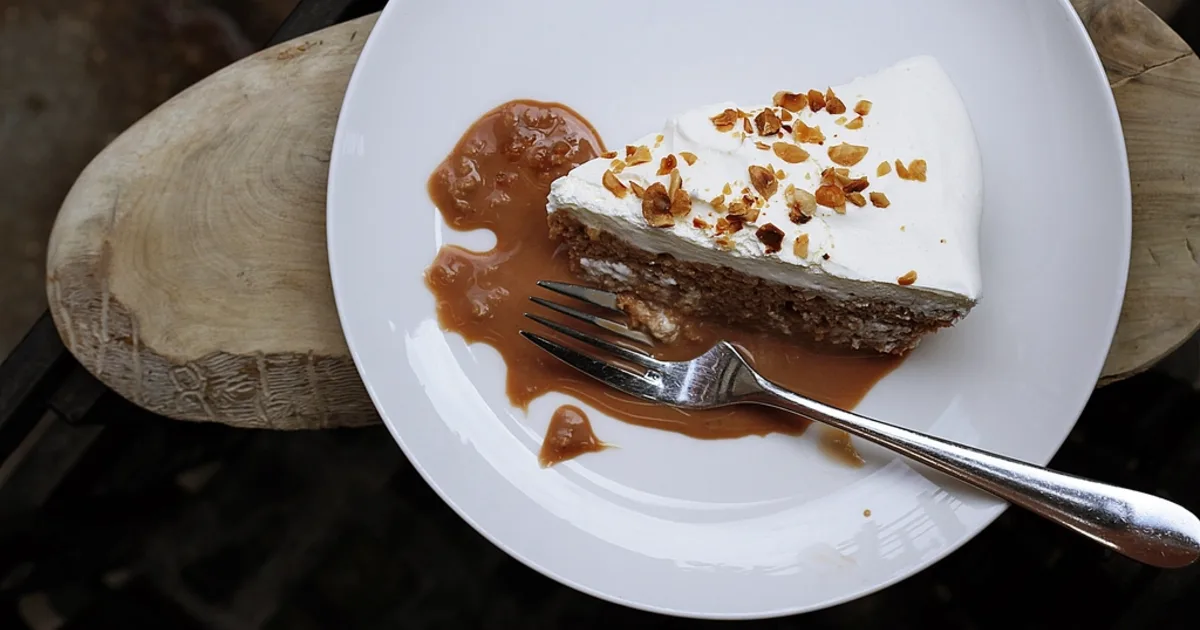
Russian Fudge: The Creamy New Zealand Vanilla Fudge
A tested method for the creamy, caramel-coloured fudge that turns up on every Kiwi Christmas platter, set with condensed milk and golden syrup.
How this was made: Recipes are developed and kitchen-tested by our editorial team. We use AI tools to assist with drafting, structuring and proof-reading; a human editor reviews and tests every recipe before publication. No fictional author is used.

Russian fudge is a New Zealand tea-table and Christmas staple, and despite the name it has no connection to Russia. It is a creamy, caramel-coloured vanilla fudge, softer and silkier than a plain sugar fudge, thanks to a tin of sweetened condensed milk and a spoon of golden syrup. The reward for a little patience at the stove is a fudge that melts on the tongue rather than crunching.
The method rewards care rather than skill. Two moments decide the outcome: dissolving the sugar fully before the mixture boils, and cooling the pot before you beat. Get those right and the rest is straightforward. If you enjoy a slow, poured sweet, you will recognise the rhythm from our caramel slice, which uses the same condensed milk and golden syrup pairing over a shortbread base.
Ingredients
For a 20 cm square tin
- 3 cups white sugar
- 1/2 cup full-cream milk
- 125 g butter, cubed
- 2 tbsp golden syrup
- 200 g sweetened condensed milk (about half a standard tin)
- 1 tsp vanilla extract
Method
- Line the tin. Grease and line a 20 cm square tin with baking paper, leaving an overhang on two sides to lift the fudge out later.
- Dissolve the sugar. Put the sugar, milk, butter, golden syrup and condensed milk in a large heavy saucepan over low heat. Stir slowly and steadily until the sugar has completely dissolved and the mixture looks smooth, with no grittiness on the back of the spoon. This step is what prevents a grainy fudge, so do not rush it.
- Boil to soft ball. Bring to a gentle boil and cook, stirring only occasionally to stop it catching, until it reaches 116°C on a sugar thermometer, the soft ball stage. Without a thermometer, drop a little into cold water: it should form a soft ball you can flatten between your fingers. This usually takes 8 to 12 minutes.
- Cool the pot. Take the pan off the heat, stir in the vanilla, and leave it undisturbed until it drops to lukewarm, barely warm to the touch. Cooling before beating keeps the sugar crystals fine and the texture creamy.
- Beat until dull. With a wooden spoon, beat steadily until the fudge loses its gloss, thickens and turns a matte shade. Watch the ripples: when they hold their shape for a second then settle, it is ready. Over-beating sets it in the pot.
- Pour and set. Working quickly, pour into the lined tin and smooth the top. Leave to set at room temperature, then lift out and cut into small squares with a warm, dry knife.
- Grainy fudge: the sugar was not fully dissolved before boiling, or the mixture was stirred too much once boiling. Dissolve patiently and stir only to prevent catching.
- Too soft, will not set: under-boiled. Next time cook a little longer to reach a firm 116°C.
- Hard or crumbly: boiled too far past soft ball. Watch the thermometer closely near the end.
- Set in the pot: beaten a moment too long. Pour the instant the gloss goes and the ripples begin to hold.
Russian fudge keeps well in an airtight container in a cool place or the fridge for two to three weeks, so it suits making ahead for a gift or a Christmas platter. Because it is very sweet, small squares are kinder than large ones. For a lighter sweet to serve alongside, our melting moments biscuits balance the richness on a shared plate. You can read more about our testing approach on the about page, or browse the full recipe index from the home page.
Sources & references
Background reading used while developing and verifying this recipe. Quantities and timings were confirmed by our own kitchen testing.
- Chelsea Sugar, Russian Fudge recipe, for traditional NZ ingredient ratios (chelsea.co.nz).
- Edmonds Cooking, Russian Fudge, for the classic condensed milk and golden syrup method (edmondscooking.co.nz).
- General confectionery references on soft ball stage (116°C) and preventing sugar crystallisation when beating fudge.